


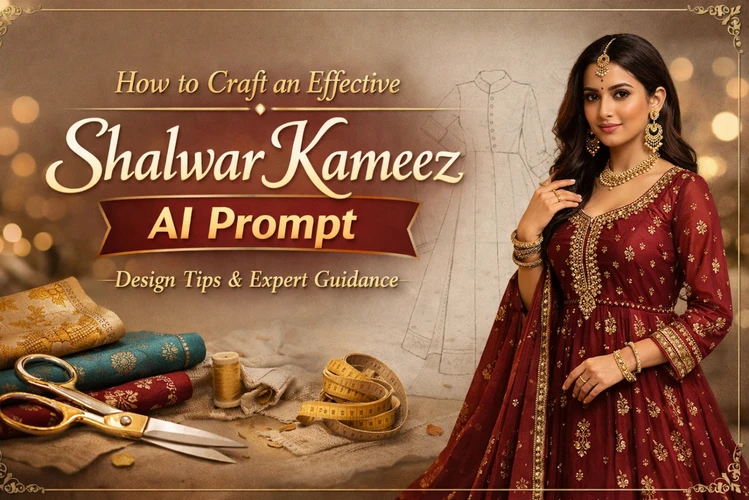
Shalwar kameez isn’t just another outfit. It’s everywhere in South Asia, especially in Pakistan, India, and Bangladesh. You’ve got the long tunic (the kameez), loose pants (shalwar), and usually a scarf or dupatta to pull it all together. It’s comfortable, looks great, and, that’s why so many people love wearing it, no matter where they live.
With AI, coming up with new designs, and creative fashion ideas for shalwar kameez has become more than convenient. Whether you’re a designer or want a unique design for yourself, in this article, we’ll share how to craft the perfect shalwar kameez AI prompt. So, you can get accurate and creative results about this much-loved outfit.
Table of Contents
- Part 1: Why a Specific AI Prompt for Shalwar Kameez Is Necessary
- Part 2: How to Give Clear Details For a Shalwar Kameez AI PromptHOT
- Part 3: Fashion Keywords for Creating Accurate Shalwar Kameez AI Prompts
- Part 4: Examples of Shalwar Kameez AI Prompts
- [Bonus Tip] Improve Your Shalwar Kameez Design With an AI Enhancer
Part 1: Why a Specific AI Prompt for Shalwar Kameez Is Necessary
If you give your tailor a fabric and say, “Make something nice,” the result may be fine. But it likely won’t match what you want. AI image tools operate the same way. They don’t understand culture or fashion. But simply follow patterns from images and text they have learned. If your prompt is unclear, the AI may mix styles and create inaccurate results.
That’s why clear and specific prompts are critical. Broad terms like “traditional dress” often lead to generic images. Using exact words such as “Anarkali flare” or “Patiala pleats” helps the AI create the right design. Think like a designer and give clear details about fabric, style, and look. The more specific your shalwar kameez prompt for Gemini or any other AI tool is, the better the final result will be.

Part 2: How to Give Clear Details For a Shalwar Kameez AI Prompt
It’s important to understand that the best shalwar kameez prompt for Gemini or any other AI generator is not just one short command. It is more of a detailed, layered plan. The details added to each layer are significant and create the end image. Here’s how:
Layer 1: Core Subject and Style
This is the starting point. Make clear what you desire and in what style. Do not use such general words as “ethnic outfit.” Rather, write with certain specifics, like a “Peshawari-style men’s shalwar kameez,” or a “fusion Anarkali bridal suit.” This defines the garment and its overall identity from the start.
Layer 2: Design and Silhouette
In this case, you account for the appearance of the outfit and its fit. Mention the cut (A-line, straight, or flared), fit (loose, tailored, or body-hugging), and length (knee-length, calf-length, or floor-length). Moreover, specify the styles of the neckline (V-neck, mandarin collar, or keyhole back) as well as sleeve styles (cap, bell, or full sleeves with cuffs) that will form the final shape.
Layer 3: Fabric and Embellishment
This layer is concerned with materials and ornamentation. Indicate materials like chiffon to create a fluid look or velvet to create a thick and deep look. Add also embroidery or style embellishment, such as chikankari, zardozi, or gota patti, each giving a different effect.
Layer 4: Context and Setting
Establish the location and position of the outfit. It may be flattened to lie on marble, made a prototype in a Mughal garden, or draped on a mannequin in a modern boutique. The environment aids in creating the atmosphere and informs AI on whether to pay attention to the details of fabric or to a complete lifestyle image.
Layer 5: Artistic and Technical Direction
This final layer controls how the image looks. Indicate the style, e.g., a photorealistic studio photograph, a watercolor fashion, or a technical drawing. Moreover, add lighting (softbox, golden hour, dramatic shadows), composition (close-up or full-body), and quality (8K, high detail) to refine the end product.

Part 3: Fashion Keywords for Creating Accurate Shalwar Kameez AI Prompts
The second thing after learning the basic structure is to select the correct words. These keywords serve as a specific guide to the AI on what image exactly you require. The following are examples of fashion keywords:
Garment Types and Styles
These words determine the primary fashion and garment design. Anarkali for women is a kameez that is long and flowing and flared, whereas sharara is wide and flared trousers, which resemble a skirt. The palazzo suit implies straight-fitting and wide-leg pants with a modern feel.
Terms like “straight-cut,” “A-line,” and “Angrakha style” (overlapping front panels) describe the silhouette. For men, Peshawari or Pathani points to a strong regional look, while Sherwani-inspired kameez suggests a longer, formal design.
Fabric and Material Keywords
Fabric words control texture, weight, and flow. Silk has a glossy look, cotton (khadi) has a matte and handmade appearance, and chiffon or georgette has a draping, soft, transparent appearance. Whereas velvet is opulent and dense, net is transparent, and jamawar brocade has weighty and elaborate weaving patterns. Each fabric affects how realistic the image looks.
Embellishment and Craft Terminology
These terms describe decoration styles. Zari is done with gold or silver thread to give it a royal look, and resham is done with colored silk threads. Whereas Lucknow chikankari is a white, finely embroidered piece of finery, and phulkari is a brightly embroidered design made in Punjab.
While mirror work adds reflective details, gota patti uses gold ribbon appliqué, and block print refers to hand-stamped patterns. Using these exact terms keeps designs accurate and well-defined.
Color and Pattern Descriptors
Go beyond basic colors. Jewel tones are available in the form of emerald, ruby, and sapphire. While earthly colors are offered in the form of ochre, moss green, and terracotta, and pastels consist of light pink, mint, and peach.
Pattern terms like paisley (buta), floral motifs, and geometric patterns shape the overall design. Moreover, monochrome focuses on texture in one color, while contrast piping adds a sharp outline to the garment.

Part 4: Examples of Shalwar Kameez AI Prompts
Here are some examples of shalwar kameez prompts to copy and paste, targeting different scenarios:
1. Product Photoshoot
“Flat lay on a white background of a [color] cotton shalwar kameez set for e-commerce. Minimal [embellishment type] embroidery on the kameez neckline. A neatly folded dupatta is placed beside it. Clean look, sharp focus, professional studio lighting.”
2. Fashion Editorial
“Vogue magazine-style image of a model wearing a high-end [style, e.g., sharara suit]. Made from [fabric] in [color] with bold [embellishment]. Shot in a grand marble courtyard at golden hour. Cinematic lighting, photorealistic, 8K quality.”
3. Design Concept Sketch
“Fashion illustration and technical sketch on a croquis. Modern, minimalist shalwar kameez with an asymmetrical kameez hemline and wide-leg palazzo shalwar. [Fabric] in [color] with [pattern]. Clean lines, annotated details, and a white background.”
4. Cultural Scene
“Photorealistic scene of a family wearing matching shalwar kameez outfits during an Eid celebration. Festive bazaar setting with string lights, joyful expressions, rich fabric details, and a lively, dynamic composition.”

[Bonus Tip] Improve Your Shalwar Kameez Design With an AI Enhancer
If you’ve generated shalwar kameez pictures for your personal needs, or you’re a designer, you can actually customize them, specifically for publishing. A free tool like Tenorshare PixPretty can batch edit pictures, and apply filters, effects, and presets to them. There is also an option to create your own filters.
What’s more, the tool has the ability to retouch portraits and change skin color and hair color, as well as refine face and body features. It can also resize, compress, and turn pictures, and remove watermarks and backdrops. Moreover, you can extend, or replace backgrounds, even complex ones, in a few clicks.
Conclusion
Crafting a strong shalwar kameez AI prompt requires clear details and structure. To come up with the correct, attractive designs, you will be required to indicate the type of garment, style, fabric, embellishments, color, and setting. The five-layered approach above will determine that all elements of the silhouette to the lighting are taken into account.
To refine your shalwar kameez images more, a free tool like Tenorshare PixPretty can help you edit, retouch, and customize AI images. It can make your shalwar kameez visuals ideal for publishing on social media, e-commerce, or marketing platforms.
PixPretty AI Photo Editor
- 100% free AI Image Generator (Nano Banana 2 powered)
- 4K image quality with fast generation speed
- AI effects & filters for personal and e-commerce use
Related Articles:
- Top 20+ Happy New Year Prompt for Gemini Boy Free [Trending]
- 20+ Trending New Year 2026 Party Photo Prompts for Stunning AI Images
- Best Polar Express ChatGPT Prompts for Christmas AI Portraits in 2026
- 20+ AI Prompts for Christmas Portraits Copy and Paste
- 20+ Police Station AI Prompts: A Complete Guide to Viral AI Images


