


Great lehenga photos matter, whether you're planning a wedding, picking out something for yourself, getting ready for a festival, or trying to boost your business. If you want AI to create really spot-on images, you have to be specific with your AI prompt for Lehenga.
Talk about the fabric, the colors, the kind of embroidery, and even the little details like sequins or beads. We’ve put together some tips and examples to help you write better prompts. There’s even a bonus tip to make your lehenga images pop, without spending a dime.
Table of Contents
Part 1: Why Create a Particular AI Prompt for Lehenga?
Using a specific AI prompt for a lehenga is important because this garment is culturally significant, detailed, and used in very particular ways. A vague prompt like “a beautiful lehenga design” will produce generic or inaccurate results. For bridal or couture design, a specific prompt ascertains that the AI captures fabrics, embroidery, and colors accurately, like deep red velvet with gold zari or champagne-peach silk with pearl tassels.
For personal styling, it can create realistic portraits showing you in your desired color lehenga with matching jewelry while keeping your features. For festive or marketing content, detailed prompts capture energy and context, such as a woman twirling at Garba with her dupatta flying under festive lights. Whereas for professional product imagery, a precise prompt helps the lehenga drape naturally on a model with correct lighting, avoiding awkward or unrealistic placement.

Part 2: Principles For Crafting the Perfect Lehenga AI Prompt
To create a good bridal lehenga prompt, you need to think like a creative director. The prompt should guide the AI clearly, just like instructions given to a designer or stylist. Instead of being vague, break the idea into simple, important details so the AI understands exactly what to create and delivers accurate, realistic results:
1. Start with the Core Subject
Start by defining the main focus of the prompt, as this decides the overall goal. A weak prompt like “an Indian outfit” is too vague and gives unclear results. A strong prompt clearly states the purpose, such as “a hyper-realistic fashion photograph of a bride in a wedding lehenga” or “a detailed technical illustration for a designer’s mood board featuring a modern lehenga,” which helps the AI create exactly what is needed.
2. Describe the Garment in Layers
This is the most important step. Thus, clearly explain each part of the lehenga so the AI understands the full outfit:
-
Choli (Blouse): Mention the style, such as sleeveless, high-neck, backless, or cape. Add the fabric, like net, silk, or velvet, and the details, such as sequins, thread embroidery, or mirror work.
-
Lehenga (Skirt): Define the shape like A-line, flared, mermaid, or panelled. Specify fabrics such as organza, silk, or georgette. Describe the design by stating where embroidery appears (all-over, border, scattered motifs). Also, mention the motif types (floral, peacock, paisley, or geometric) and techniques like zardozi, gota patti, or stone work.
-
Dupatta (Scarf/Veil): Explain how it is worn (over the head, on shoulders, or pinned), and its fabric transparency, like sheer chiffon or opaque velvet. Also, mention how its embellishment matches the outfit, such as a heavy border or matching embroidery.
3. Set the Scene and Mood
You can add realism and beauty by setting the mood of the image clearly. Here’s how:
-
Location & Ambiance: Describe the setting, such as inside a grand marble palace temple, at a lively outdoor sangeet with fairy lights, or a minimalist studio set with dramatic lighting.
-
Model’s Pose & Action: Mention what the model is doing, like dancing gracefully with a flowing dupatta, sitting regally on a throne, or walking down an aisle.
-
Color Palette & Lighting: Specify colors and light, such as rich emerald and gold in soft, diffused lighting, or vibrant fuchsia and orange under bright midday festival sunlight.
4. Specify Technical and Artistic Style
These details control the final look and quality of the image:
-
1. Art Style: Choose the style, such as photorealistic in 8K resolution, a watercolor painting look, or a digital fashion sketch with fabric swatches.
-
2. Camera & Composition: Define the shot, like a close-up with shallow depth of field showing embroidery details. You can also include a full-body cinematic wide-angle shot, or a side profile highlighting the flow of the skirt.


1. Silhouette & Cut
-
A-Line Lehenga: Widens slowly from the waist and suits most body types.
-
Circular or Flared Lehenga: Very wide and voluminous for a dramatic, grand look.
-
Mermaid (Fishtail) Lehenga: Fitted until the knees, then flares out sharply.
-
Sharara or Gharara Lehenga: Uses wide-legged pants that flare from the knee or waist.
-
Straight Cut Lehenga: Has a clean, straight, column-style shape.
-
Jacket or Cape Lehenga: Includes a long or short jacket or cape for a layered style.
2. Fabrics & Materials
-
Luxurious & Rich: Silk, velvet, and brocade (woven with metallic threads).
-
Sheer & Ethereal: Organza (light and sheer), chiffon (soft and flowing), and net.
-
Traditional & Woven: Banarasi silk, Chanderi, and Kanjeevaram silk.
3. Embellishments & Embroidery
-
Metallic & Traditional: Zardozi (detailed metallic threadwork), gota patti (thin metallic ribbon work), and zari (gold or silver thread embroidery).
-
Sparkle & Texture: Sequins, stone or crystal work, beadwork, and mirror work.
4. Colors & Themes
-
Traditional Bridal: Red (signifies prosperity), maroon, and gold.
-
Modern & Pastel: Blush pink, mint green, lavender, peach, and other pastel shades.
-
Vibrant Festive: Electric blue, hot pink, emerald green, and royal purple.
5. Regional & Cultural Styles
-
1. Rajasthani Lehenga: Known for gota patti work and bold, vibrant colors.
-
2. Gujarati Lehenga / Chaniya Choli: Uses mirror work, pleated skirts, and bright shades.
-
3. Punjabi Phulkari Lehenga: Features colorful floral embroidery called phulkari.
-
4. South Indian Lehenga: Usually red or gold, made from rich silk with zari borders.
-
5. Bengali Lehenga: Often in red, yellow, or saffron, sometimes using jamdani fabric.
-
6. Kashmiri Lehenga: Made from velvet or brocade with detailed aari embroidery.
-
7. Indo-Western / Fusion Lehenga: Includes modern cuts, cape blouses, asymmetrical hems, and contemporary fabrics.

Part 4: Examples of AI Prompts For Lehenga
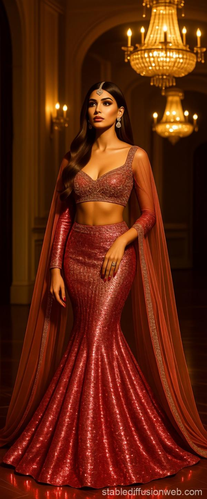
Here are 5 examples of lehenga prompts you can use to generate pictures with ChatGPT, Gemini, Midjourney, Stable Diffusion, etc. You can also mix and match using the principles and keywords mentioned in the earlier sections:
1. Traditional Rajasthani Bride
Ultra-realistic fashion photo of a Rajasthani bride in a deep red velvet flared lehenga with gold zardozi, silver gota patti, and mirror work. Sleeveless deep-back choli, sheer red organza dupatta with gold brocade border, heavy polki necklace, jhumka earrings, and maang tikka. Set in a grand palace courtyard at golden hour, soft diffused lighting, photorealistic, 8K, hyper-detailed.

2. Modern Pastel Fusion Lehenga
Fashion editorial of a modern Indo-Western lehenga. A-line blush pink silk chiffon skirt with 3D floral appliqués and pearl beadwork. Structured crop-top blouse with sweetheart neckline and cap sleeves. Flowing oversized sheer peach stole instead of a dupatta. Minimalist white studio backdrop with dramatic lighting, medium-format camera, and sharp focus.

3. Vibrant Gujarati Garba Lehenga in Motion
Action shot of a dancer mid-spin at Navratri wearing a flared lehenga and chaniya choli in electric blue cotton silk with mirror work and circular thread embroidery. Short-sleeved, backless choli, dupatta flying in motion. Night festival setting with blurred fairy lights and other dancers, cinematic style, slight motion blur, and vibrant colors.

4. Detailed Technical Illustration for Design
Flat technical illustration showing the front and back of a mermaid (fishtail) lehenga. Emerald green brocade with an all-over paisley motif, and heavy embroidery on the hem and panels with gold zari, green stones, and maroon threadwork. High-neck, full-sleeve blouse, sheer gold tissue dupatta. White background, precise lines, and watercolor and ink style.

5. Personal Styling Visualization
Clear, front-facing, well-lit photo. Keep face, body, and pose identical. A girl wearing a royal blue circular silk lehenga with silver peacock embroidery, a sleeveless keyhole choli, and a silver-trimmed net dupatta over the shoulders. The background remains a simple blur, photorealistic, and flawlessly integrated.

[Bonus Tip] Apply Custom Filters on Your Generated Lehenga Pictures
If you’ve already generated lehenga pictures and now want to improve them, like add custom filters to them, then employ a free AI Enhancer like Tenorshare PixPretty. It allows you to make your own custom filters to add, or you can pick from ready-made filters, presets, and shadow effects. The tool also allows you to retouch faces, hair, and skin, and refine body features. Moreover, you can resize, compress, and convert images, and remove watermarks or backgrounds. The tool can replace or extend backgrounds, even complex ones.
Conclusion
Creating a detailed AI prompt for lehenga is important for capturing its cultural richness, fabric, embroidery, colors, and style. Whether you want pictures for bridal looks, personal styling, festivals, or products, clear prompts help the AI produce realistic, and beautiful images.
The results also show all layers, poses, and moods accurately. After generating the lehenga pictures, a free tool like Tenorshare PixPretty can improve them further with custom filters, retouching, resizing, and background editing for professional visuals.
PixPretty AI Photo Editor
- 100% free AI Image Generator (Nano Banana 2 powered)
- 4K image quality with fast generation speed
- AI effects & filters for personal and e-commerce use
Related Articles:


