


Pohela Boishakh is the Bengali New Year, celebrated in Bangladesh, West Bengal (India), and by Bengali communities worldwide. It usually takes place on April 14 or 15 and marks the beginning of the Bengali calendar. Nowadays, you can capture the spirit of Pohela Boishakh by creating images for social media, design ideas, and digital art with AI image generators.
However, without the appropriate Pohela Boishakh decoration AI prompts, you won't get authentic results. But we can help you with 30+ ready-made AI prompt examples you can use or mix and match to create beautiful visuals. In this post, we've also included a simple guide to help you make your own prompts, along with tips to avoid generic results.

Table of Contents
- Part 1: Enrich the Cultural Background Behind Pohela Boishakh
-
Part 2: 30+ Ready-Made Examples for Pohela Boishakh Decoration AI
PromptsHOT
- Clay and Terracotta Pohela Boishakh Decoration AI Prompts
- Floral and Botanical Pohela Boishakh Decoration AI Prompts
- Textile and Fabric Pohela Boishakh Decoration AI Prompts
- Ritual and Ceremonial Pohela Boishakh Decoration AI Prompts
- Craft and Folk Art Pohela Boishakh Decoration AI Prompts
- Food and Sweet Displays Pohela Boishakh Decoration AI Prompts
- Entrance and Doorway Pohela Boishakh Decoration AI Prompts
- Part 3: How to Create Effective Boishakh Decoration AI Prompts
- Part 4: Tips for Creating Stunning Pohela Boishakh Decoration AI Prompts
- Part 5: Use an AI Image Describer to Aid You In Writing Pohela Boishakh Prompts
- Share Your Pohela Boishakh Creations!!
- FAQs About Pohela Boishakh Decoration AI Prompts
- The Bottom Line
Part 1: Enrich the Cultural Background Behind Pohela Boishakh
Pohela Boishakh is the "first day of Boishakh," the first month of the Bengali calendar introduced by Emperor Akbar in the 16th century to align tax collection with harvests. Today, it represents Bengali cultural identity more than anything else.
One of its important celebrations is the Mangal Shobajatra, a UNESCO-recognized tradition since 2016 that began at Dhaka University in 1989. It's a symbol of resilience, featuring large papier-mâché masks of owls (wisdom), tigers (courage), and fish (prosperity).
Pohela Boishakh is celebrated widely across Bangladesh, West Bengal, and diaspora communities in cities like London and New York as a shared expression of Bengali identity. Here are the important traditions of this festival at a glance:
-
Food: Panta bhat with ilish, a fermented rice soaked overnight, served with fried hilsa fish, green chilies, and dried chili. The meal is earthy, sour, and irreplaceable.
-
Music: Baul and Rabindra Sangeet. Dawn begins with Tagore's "Esho he Boishakh," a song inviting the new year in. Baul folk musicians play ektara and duggi in open courtyards throughout the morning.
-
Commerce: Halkhata (new account books). Merchants open fresh account ledgers on this day, invite customers for mishti (sweets), and clear old debts, a tradition of financial renewal dating back centuries.
-
Craft: Nakshi kantha and pata chitra: Embroidered quilts and scroll paintings are displayed and gifted during celebrations. Each stitch and motif tells a story, as these crafts are living folk archives.
-
Art: Alpana floor art, a rice-paste pattern drawn on floors, thresholds, and courtyards to welcome the new year. Each motif carries meaning: the lotus for purity, the fish for abundance, and the paddy for harvest. Alpana appears in doorway, ritual, and entrance prompts throughout precisely because it marks sacred and celebratory spaces.
-
Ritual: Puja and ceremonial offerings use brass kalash pots, conch shells, pradeep oil lamps, and kumkum vermillion. They are arranged on ritual trays as offerings to mark the auspicious start of the year.
-
Dress: White sari with red border: Women traditionally wear white muslin saris with red borders, while men wear white panjabis. This is why the red-and-white palette dominates authentic Boishakh decoration AI prompts.
Part 2: 30+ Ready-Made Examples for Pohela Boishakh Decoration AI Prompts
The following are 30+ ready-made examples for Pohela Boishakh AI prompts you can copy and paste into an AI image generator. Pick from any category:
Clay and Terracotta Pohela Boishakh Decoration AI Prompts
Pohela Boishakh decorations feel most special when they reflect simple, earthy beauty. Here are some prompts for Pohela Boishakh decoration AI photos for clay and terracotta pieces to bring warmth, tradition, and a natural festive charm to any space:
-
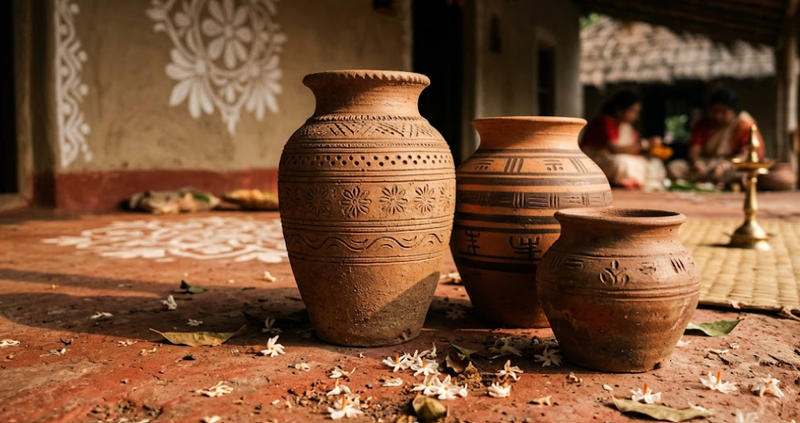
1.Terracotta Pot Cluster Arrangement: Cluster of three hand-thrown terracotta clay pots of varying heights with traditional Bengali incised band patterns, arranged asymmetrically. Earthy folk craft and Pohela Boishakh aesthetic. The pots are placed on a rough red clay floor with scattered dried shiuli petals, and soft morning sidelight casting long shadows. 8K ultra-detailed clay grain texture, warm cinematic color grade, and ceremonially abundant.
-
2.Matir Kuri with Marigold Garland: A single large matir kuri (Bengali clay water pot) with a natural iron oxide finish and a fresh marigold garland draped over its neck. Vibrant, festive editorial and Pohela Boishakh aesthetic. The matir kuri is positioned on a banana leaf spread against a whitewashed mud-plastered wall. Golden hour warm glow from the lower left, DSLR macro editorial quality, rich terracotta texture detail, and harvest warmth.
-
3.Terracotta Pradeep Lamp Row: A row of seven small terracotta pradeep oil lamps with cotton wicks and pools of golden mustard oil, arranged in a straight line. Ceremonial ritual close-up and Pohela Boishakh aesthetic. The lamps are placed on a stone temple step with an alpana chalk-painted border. Flickering earthen lamp dusk glow. 8K ultra-detailed, shallow depth of field with a bokeh flame background, and devotionally luminous.
-
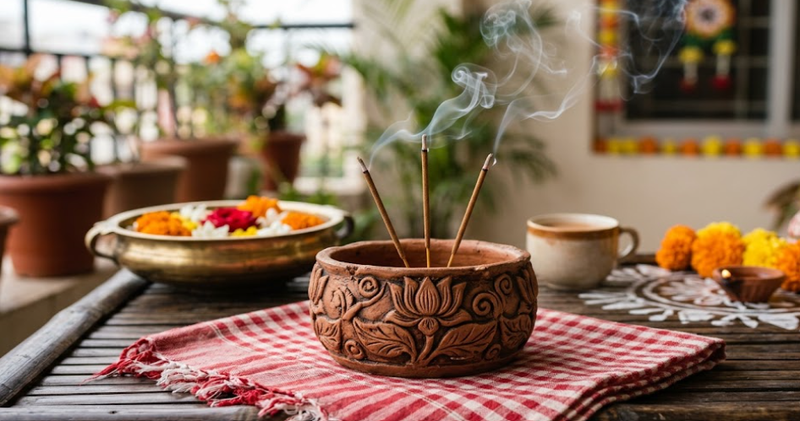
4.Lotus Carved Incense Holder: A carved terracotta incense holder shaped with a traditional lotus relief pattern, with three lit agarbatti sticks releasing thin coils of white smoke. Contemporary fusion décor and Pohela Boishakh aesthetic. The holder is resting on a hand-stitched cotton gamcha fabric on a dark bamboo surface. Diffused overcast morning light, DSLR editorial quality with bokeh smoke detail, and serenely fragrant.
-
5.Terracotta Folk Figurine Collection: Collection of five hand-painted terracotta folk figurines. Elephant, horse, owl, fish, and peacock, arranged in a semicircle on a woven bamboo mat. Bengali folk art documentary and Pohela Boishakh aesthetic. The figurines are against a jute-draped backdrop with soft ochre tones. Warm afternoon harvest sunlight from the right, 8K ultra-detailed paint texture, vibrant yet earthy palette, and joyfully handcrafted.


Floral and Botanical Pohela Boishakh Decoration AI Prompts
Floral and botanical elements bring freshness and life into Pohela Boishakh décor. Here are some AI prompts that add color, fragrance, and a natural festive spirit that feels both traditional and vibrant:
-
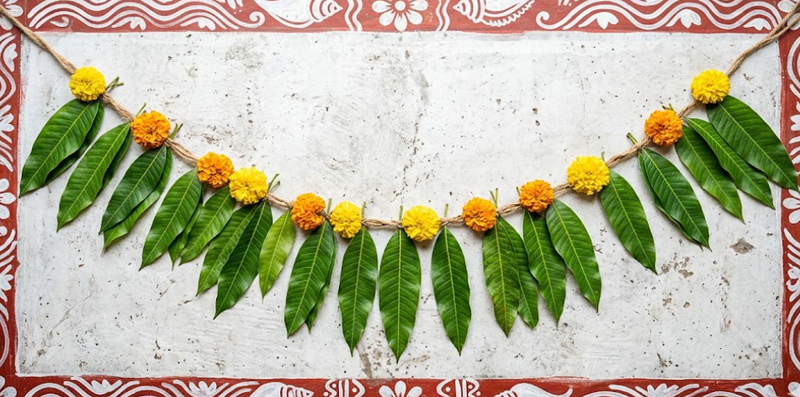
1.Mango Leaf Torana with Marigolds: Fresh green mango leaf torana (decorative doorway arch) strung on jute twine with interspersed bright yellow marigolds. Bengali minimalist flat lay aesthetic photographed from directly below, laid flat on a whitewashed concrete floor with a red alpana border. Bright midday overhead Pohela Boishakh festival light, DSLR editorial quality, rich leaf-vein texture detail, auspiciously festive.
-
2.Marigold and Hibiscus Floral Arrangement: Overhead flat lay of three interlaced marigold garlands in deep orange and golden yellow, forming loose concentric circles, with scattered red hibiscus joba in full bloom. Vibrant Pohela Boishakh festive editorial aesthetic. Garlands are placed on a fresh banana leaf surface. Bright neutral studio-quality daylight, 8K ultra-detailed petal texture, warm cinematic color grade, and overflowingly abundant.
-
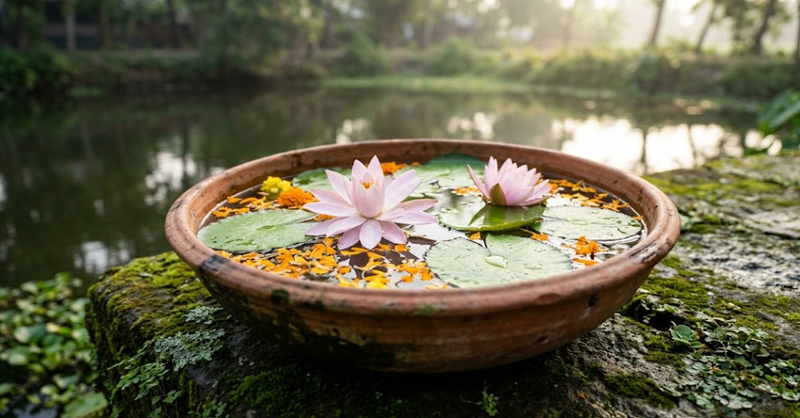
3.Lotus Bowl Water Arrangement: Two pale pink lotus blooms are floating in a wide terracotta water bowl with fresh green lily pads, alongside submerged marigold petals. Soft village morning, still life, and Pohela Boishakh aesthetic. The bowl is placed on a moss-covered stone surface near water. Early morning soft diffused haze, DSLR macro close-up quality, shallow depth of field with bokeh water reflections, and peacefully meditative.
-
4.Shiuli Flowers on Alpana Floor: Scattered white and orange shiuli (night jasmine) flowers fallen on a deep red alpana-painted clay floor, forming a natural, organic pattern. Vintage cultural documentary and Boishakh aesthetic. A single empty terracotta pot in one corner. Cool blue-grey pre-dawn light, 8K ultra-detailed, flat lay overhead angle, warm vintage film tones, and quietly poetic.
-
5.Festival Flower Basket Display: A woven bamboo basket overflowing with mixed Bengali festival flowers. Red hibiscus, white tuberose, yellow marigold, and pink bougainvillea, with a jute handle tied with red thread. Earthy rustic documentary and Boishakh aesthetic. The basket is placed on a worn wooden market table. Warm golden afternoon harvest sunlight, 8K ultra-detailed, rich bokeh background with soft green foliage, and abundantly celebratory.


Textile and Fabric Pohela Boishakh Decoration AI Prompts
Textiles and fabrics add softness and depth to Pohela Boishakh decorations. Here are some Pohela Boishakh design AI prompts with patterns, colors, and handcrafted details that bring a cozy yet festive cultural feel to any setting:
-
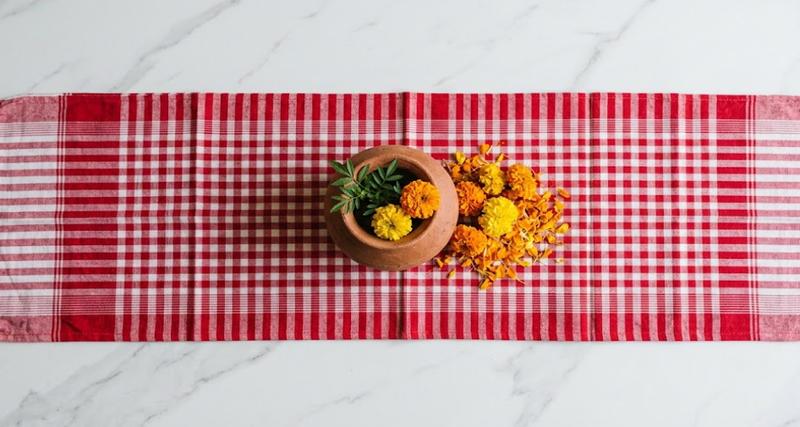
1.Gamcha Table Runner Setup: Traditional red-and-white checked Bengali gamcha fabric spread flat as a table runner, with fold lines still visible, topped by a single terracotta pot and a handful of marigolds. Bengali minimalist flat lay and Pohela Boishakh aesthetic. Smooth white marble-effect surface, bright clean overhead daylight, DSLR editorial quality, rich cotton thread texture, and crisp and culturally grounded.
-
2.Nakshi Kantha Quilt Display: A folded nakshi kantha patchwork quilt with dense hand-stitched geometric Bengali folk motifs in red, blue, and ochre thread on cream cotton, displayed unfolded in a diagonal flat lay. Contemporary fusion décor and Pohela Boishakh aesthetic. Plain linen backdrop, soft diffused window light from the left, 8K ultra-detailed stitch texture, warm vintage film tones, and intimately handcrafted.
-
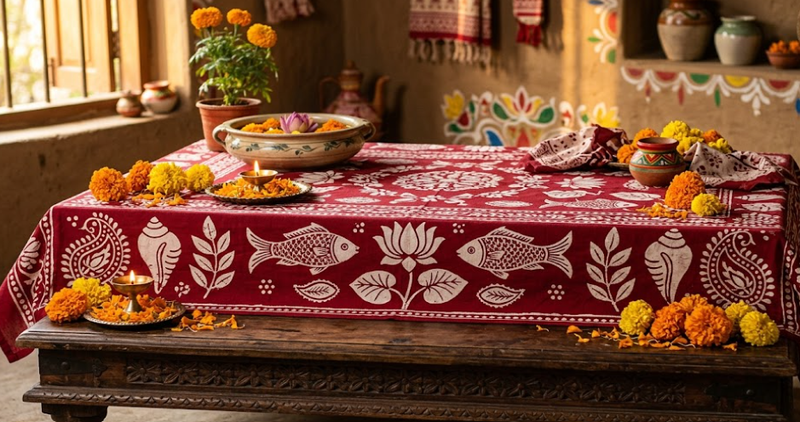
3.Alpana Motif Table Cover: Handblock-printed cloth table cover with traditional alpana (Bengali rice-paste art) motifs. Fish, lotus, and conch shell, in white on a deep red cotton ground, laid as a full table spread. Vibrant festive editorial and Pohela Boishakh aesthetic. Styled on a low carved wooden table with scattered marigolds at corners, warm golden hour side-light, DSLR quality, and richly patterned.
-
4.Sitalpati Mat Arrangement: Fine-woven sitalpati (cool mat) in natural green-and-cream stripes with a bamboo border, spread diagonally across the frame, with a single clay incense holder placed at its center. Earthy rustic documentary and Pohela Boishakh aesthetic. Red clay courtyard floor, midday harsh overhead festival light creating strong geometric shadows, 8K ultra-detailed weave texture, and deeply traditional.
-
5.Embroidered Festival Cushion Set: Three embroidered Bengali festival cushions with karchupi mirror-work and red-white floral thread patterns, stacked and fanned slightly. Soft ethnic portrait and Pohela Boishakh aesthetic. Against a whitewashed wall with a mango leaf arch partially visible, soft warm morning haze lighting, DSLR editorial quality, shallow depth of field, bokeh background, and warmly festive.


Ritual and Ceremonial Pohela Boishakh Decoration AI Prompts
Ritual and ceremonial elements give Pohela Boishakh décor a deeper spiritual meaning. The following traditional AI prompts reflect devotion, purity, and the sacred atmosphere of the celebration:
-
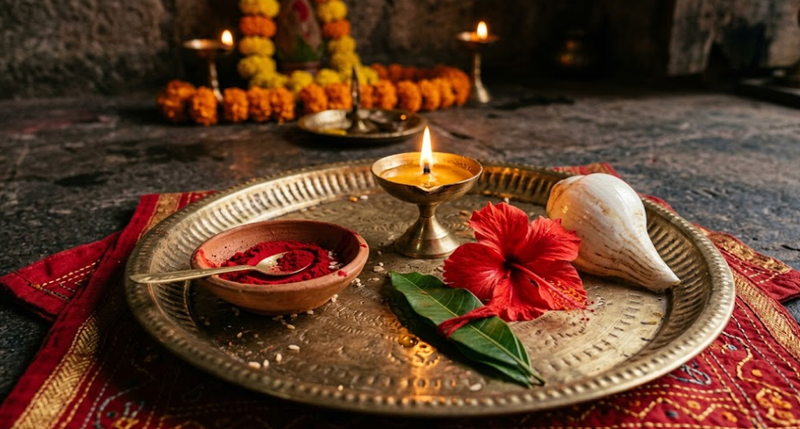
1.Brass Puja Thali Arrangement: A brass puja thali (ritual tray) holding a pradeep oil lamp, a small terracotta kumkum (vermillion) dish, a white conch shell, a single red hibiscus, and a folded green mango leaf. Ceremonial Pohela Boishakh ritual close-up aesthetic. Red embroidered cloth on a stone floor, a flickering warm lamp glow against a dim background, an 8K ultra-detailed brass texture, and devotionally sacred.
-
2.Kalash with Coconut and Mango Leaves: A polished brass kalash (ceremonial water pot) with five fresh mango leaves fanned out from its mouth and a single coconut placed on top, tied with red thread at the neck. Bengali minimalist flat lay and Pohela Boishakh aesthetic. From a 45-degree angle, on a white alpana-painted floor, bright, clean festival daylight, DSLR editorial quality, deep brass sheen, and auspiciously ceremonial.
-
3.Conch, Incense, and Bell Setup: Grouping of a large white conch shell, two lit terracotta incense holders releasing curling smoke, and a small brass bell on a hand-stitched kantha cloth. Vintage cultural documentary and Pohela Boishakh aesthetic. Aged teak wooden surface, warm afternoon amber side-light, 8K ultra-detailed, shallow depth of field, rich material contrast, and spiritually resonant.
-
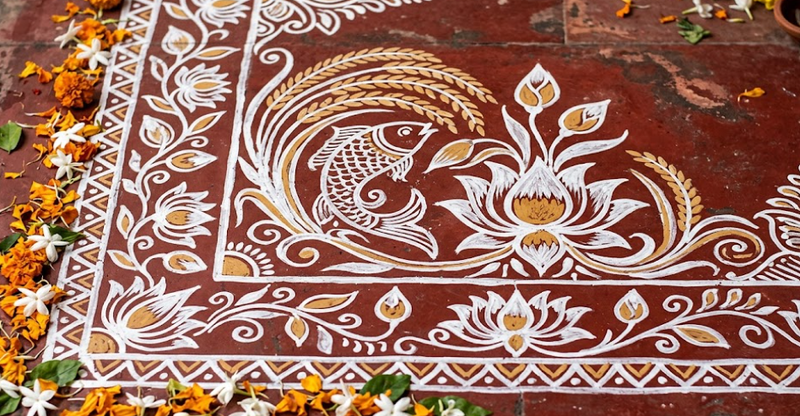
4.Alpana Floor Art Close-Up: A close-up of a freshly drawn Bengali alpana (rice-paste floor art) pattern featuring fish, paddy, and lotus motifs in white and ochre-yellow on a deep red clay floor. Earthy folk-craft documentary and Pohela Boishakh aesthetic. Scattered flower petals on the border, bright midday overhead festival light, DSLR macro quality, ultra-detailed chalk texture, and devotionally intricate.
-
5.Terracotta Diya Grid Arrangement: Cluster of nine lit terracotta diyas (earthen lamps) arranged in a 3x3 grid on a stone step with red kumkum powder dots between them. Ceremonial Pohela Boishakh ritual aesthetic. Against a deep blue dusk sky background, a warm orange flame glows, illuminating the clay surfaces from below, an 8K ultra-detailed bokeh background of soft lamp points, and sacredly luminous.


Craft and Folk Art Pohela Boishakh Decoration AI Prompts
Craft and folk art elements bring storytelling and personality into Pohela Boishakh décor. These Pohela Boishakh AI art prompts display handmade pieces that reflect tradition, creativity, and the joyful spirit of Bengali culture:
-
1.Bamboo Wind Chime Display: Set of hand-carved bamboo wind chimes tied with red cotton thread, hanging in an overlapping cascade, with painted folk motifs of fish and birds on each segment. Bengali folk art documentary and Pohela Boishakh aesthetic. A rough jute-draped backdrop, soft diffused courtyard morning light, DSLR editorial quality, rich bamboo grain texture detail, and cheerfully melodic.
-
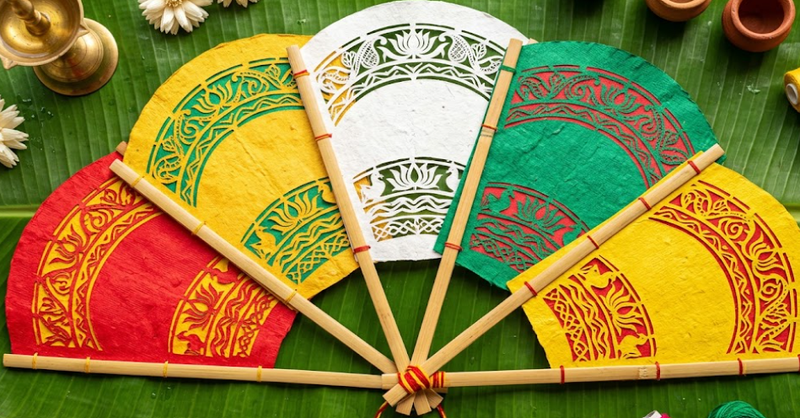
2.Colorful Paper Fan Arrangement: Five brightly colored handmade paper fans in red, yellow, white, and green with traditional Bengali cut-paper borders, arranged in a fanned-out flat lay from a single central point. Vibrant, Pohela Boishakh festive editorial aesthetic. On a fresh banana leaf surface, bright overhead neutral daylight, 8K ultra-detailed paper grain, warm cinematic color grade, and playfully festive.
-
3.Baul Doll Musical Setup: Hand-painted terracotta Baul singer doll beside a miniature clay ektara (one-string instrument) and a small clay duggi drum, arranged as a still-life trio. Earthy folk craft and Pohela Boishakh aesthetic. On a woven sitalpati mat against a whitewashed village wall, warm golden hour sidelight, DSLR editorial quality, rich paint and clay texture, and culturally soulful.
-
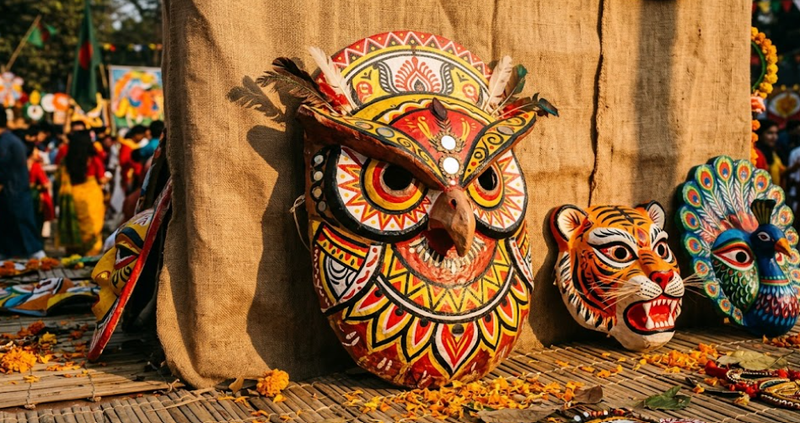
4.Mangal Shobajatra Mask Display: An oversized hand-painted papier-mâché Mangal Shobajatra owl mask with bold black outlines, vivid red, yellow, and white geometric folk patterns, and a protruding beak, displayed upright, leaning against a jute-draped backdrop alongside a smaller tiger mask and a peacock mask. Earthy folk art documentary and Pohela Boishakh aesthetic. On a woven bamboo mat with scattered marigold petals at the base, warm golden hour sidelight casting dramatic mask shadows, DSLR editorial quality, rich papier-mâché texture detail, 8K ultra-detailed, and boldly triumphant.
-
5.Pata Chitra Scroll Display: Rolled and partially unrolled pata chitra (Bengali scroll painting) fragment showing traditional folk figures in red, black, and ochre on aged cream paper, displayed on a dark bamboo mat with a single earthen lamp beside it. Vintage cultural documentary and Pohela Boishakh aesthetic, warm amber candle-side-light, DSLR editorial quality, rich aged-paper texture, and historically resonant.


Food and Sweet Displays Pohela Boishakh Decoration AI Prompts
Food displays are at the heart of Pohela Boishakh celebrations, bringing people together through taste and tradition. Here are some AI prompts that reflect abundance, warmth, and cultural joy:
-
1.Mishti Doi Earthen Pot Setup: Two traditional earthen-clay mishti doi (sweet yogurt) pots sealed with white paper tops, tied with red thread, and placed on a banana leaf alongside a small brass spoon. Bengali minimalist flat lay and Pohela Boishakh aesthetic. On a worn wooden market table with scattered marigold petals, soft warm morning sidelight, DSLR macro editorial quality, rich clay grain texture, and sweetly festive.
-
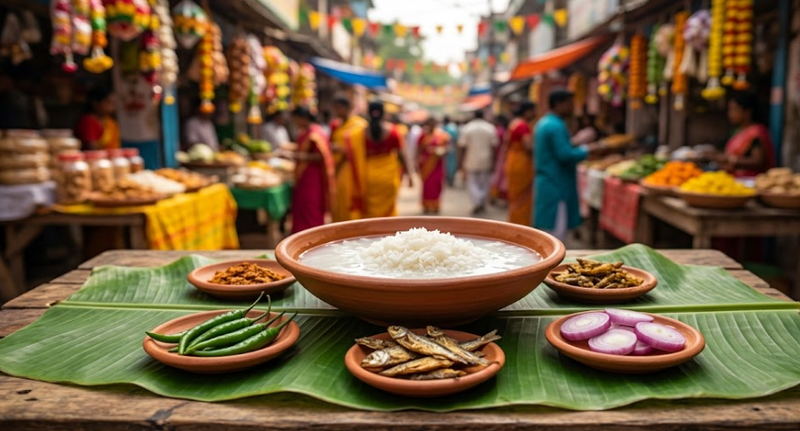
2.Panta Bhat Traditional Spread: Wide shallow clay bowl (panta bhari) filled with white panta rice and water, surrounded by small terracotta plates holding green chili, dried fish, and sliced onion, placed on a fresh banana leaf. A vibrant street market spread and Pohela Boishakh aesthetic, bright midday overhead festival light, 8K ultra-detailed surface, warm cinematic color grade, and earthy and celebratory.
-
3.Batasa Sweet Pyramid Display: Pyramid arrangement of white sugar batasa (Bengali sugar drops) stacked on a round, polished brass tray, surrounded by a border of small dried marigold petals. Ceremonial ritual close-up and Pohela Boishakh aesthetic. On an embroidered red cloth with a white alpana border, soft, warm afternoon window light, DSLR macro quality, bokeh background, and pure and auspicious.
-
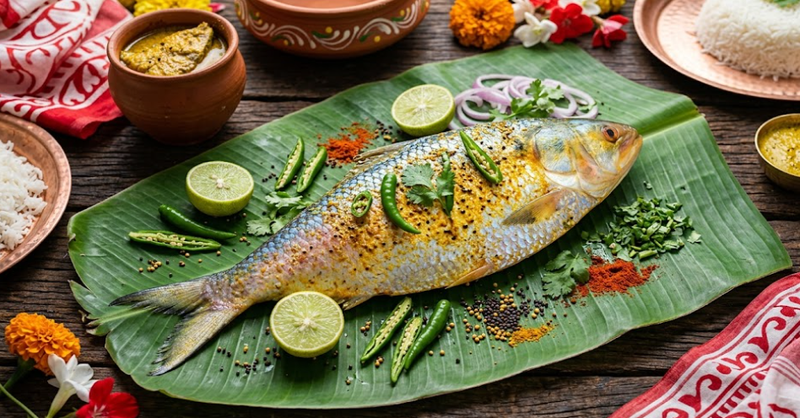
4.Hilsa Fish Festive Presentation: A whole fresh cooked hilsa (ilish) fish with silver-blue iridescent scales, placed diagonally on a large opened banana leaf with mustard seeds, dusted with turmeric, and garnished with green chilies and lime halves, placed on a dark wooden surface. Vibrant Pohela Boishakh festive editorial aesthetic, bright, even studio-quality daylight, 8K ultra-detailed scale texture, and festively abundant.
-
5.Bengali Sweets Festival Platter: Overhead flat lay of seven varieties of Bengali festival sweets. Rasgolla, sandesh, pantua, jolbhora, laddu, naru, and chomchom, each on a separate small banana leaf square, arranged in a circular pattern on a woven bamboo mat. Vibrant Pohela Boishakh festive editorial aesthetic, bright midday overhead light, DSLR editorial quality, rich texture, joyful and indulgent.


Entrance and Doorway Pohela Boishakh Decoration AI Prompts
Entrance decorations set the tone for Pohela Boishakh celebrations, creating a warm and inviting first impression. These doorway AI prompts combine tradition and creativity to welcome guests with festive charm:
-
1.Mangal Shobajatra Mask Entrance: Three large Mangal Shobajatra processional masks. A sun-face, a mythical fish, and a crocodile, mounted in a horizontal row on a rough whitewashed clay wall above a doorway, each decorated with traditional Bengali geometric patterns in red, black, and mustard yellow and draped with mango leaf strings between them. Pohela Boishakh festive editorial aesthetic, bright midday overhead festival light with hard shadows on the wall texture, 8K ultra-detailed painted surface, vibrant yet earthy palette, DSLR wide-angle editorial quality, and culturally triumphant.
-
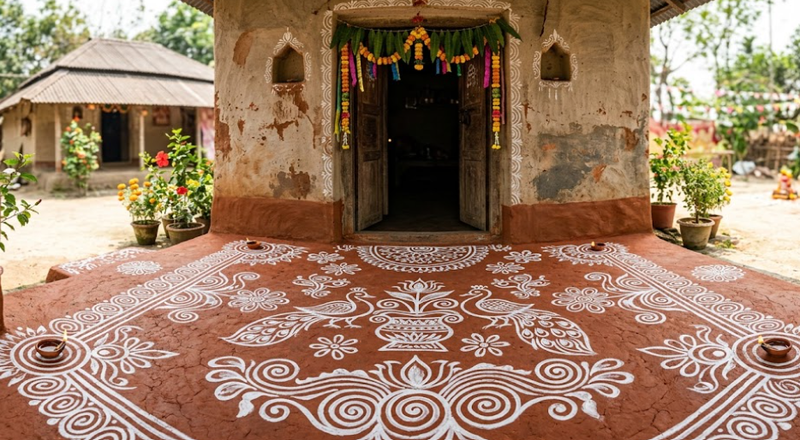
2.Alpana Doorstep Ceremony Setup: Wide-angle view of a full doorstep area with freshly drawn white rice-paste alpana patterns extending two meters across a red clay floor, with a terracotta lamp at each corner and a mango-leaf torana above the door frame visible in the background. Earthy documentary and Pohela Boishakh aesthetic, bright midday overhead festival light, 8K ultra-detailed, and beautifully ceremonial.
-
3.Terracotta Fish Hanging Mobile: Three strings of small, hand-painted terracotta fish mobiles hanging at different heights in a doorway, each fish painted with red and white traditional Bengali patterns, swaying slightly. Contemporary fusion décor and Pohela Boishakh aesthetic. A blurred open-air courtyard background, diffused afternoon light creating soft shadows, DSLR quality with bokeh, and charmingly cultural.
-
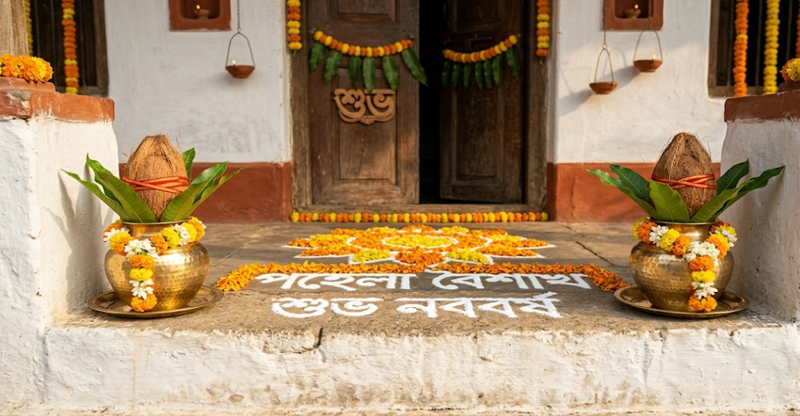
4.Kalash and Floral Rangoli Entrance: Symmetrical threshold arrangement of two brass kalash pots with coconuts and mango leaves flanking a central rangoli of marigold petals spelling a Bengali sun motif. Bengali minimalist Pohela Boishakh aesthetic. A whitewashed stone entrance step, clean bright morning festival light, 8K ultra-detailed, warm golden tones, and grandly welcoming.
-
5.Fabric Bunting Festival Arch: Hand-sewn red and white fabric bunting with small embroidered fish and lotus motifs, strung across a courtyard entrance and interwoven with fresh marigold blooms and mango leaves. Pohela Boishakh festive editorial aesthetic. A blue open-sky background with sunlight breaking through from the upper right, DSLR editorial quality, a vibrant yet natural palette, and jubilantly festive.


Part 3: How to Create Effective Boishakh Decoration AI Prompts
Besides the 30+ ready-made examples of Boishakh AI prompts given above, you can also build your own prompts. But before that, it's important to understand how small details can completely change your generated visuals.
A clear structure aids the AI in creating more realistic, culturally rich, and visually appealing results. The guide beneath can help you turn your ideas into prompts that feel festive, authentic, and ready for social media or other platforms:
Step 1: Pick Your AI Image Platform
Pick an AI Image Generator based on the visual mood you want. Midjourney and Adobe Firefly support intricate South Asian decorative motifs most faithfully. That being said, test the same prompt across several platforms before committing, because color rendering and cultural accuracy vary widely between tools.
Step 2: Define Your Pohela Boishakh Subject Clearly
Vague prompts produce generic "festival table" results. Thus, specify the exact object type, material, and cultural context. These specifics make up the identity of your image. For instance:
-
Traditional objects: Clay pot (matir kuri), terracotta water jug, brass oil lamp (pradeep), bamboo basket, clay incense holder, earthen bowl, and woven sitalpati mat.
-
Textile & fabric elements: Red-and-white sari fabric draped as a backdrop, gamcha textile spread, alpana-printed cloth runner, and embroidered table cover in Bengal motifs.
-
Floral & botanical: Marigold garland arrangement, fresh jasmine string, red hibiscus (joba ful) bunch, mango leaf torana (doorway arch), banana leaf spread, and lotus float.
-
Food & ritual objects: Decorated mishti doi earthen pot, panta bhari (fermented rice clay bowl), hilsa fish on banana leaf, batasa arrangement, and clay plate with sweets.
-
Paper & craft items: Handmade paper fan, clay figurines, nakshi kantha patchwork display, bamboo wind chimes, and paper flags in red and white.
Step 3: Choose a Trending Visual Aesthetic
This step most directly affects your image's reach on a platform during the Boishakh season. Each of these aesthetics performs strongly on Instagram, Pinterest, and YouTube thumbnails:
-
Earthy folk craft style: Terracotta, handmade, and warm, rustic tones.
-
Bengali minimalist flat lay: Overhead shot, white or banana-leaf base, and structured arrangement.
-
Vibrant festive editorial: Bold red-white-yellow palette, and commercial quality.
-
Vintage cultural documentary: Aged film grain, and muted ochres, and greens.
-
Soft village morning still life: Diffused natural light, organic textures.
-
Ceremonial ritual close-up: Macro detail, sacred mood, and incense smoke.
-
Contemporary fusion table décor: Modern styling with traditional objects.
-
Handcrafted artisan showcase: Emphasis on craft texture and material detail.
-
Colorful street market spread. Chaotic abundance, and market stall aesthetic.
Step 4: Set the Scene, Location & Lighting
A well-chosen Bengali setting turns ordinary Pohela Boishakh decoration AI prompts into something resonant and shareable. Here, you can mix and match from these combinations:
-
Surface & base: Banana leaf, woven bamboo mat, aged wooden table, red clay floor, white alpana-painted floor, embroidered gamcha fabric, cracked terracotta tile, etc.
-
Background settings: Mud-plastered village wall, whitewashed courtyard wall with alpana motifs, jute-draped backdrop, open courtyard with glimpse of mango tree, stone temple step, etc.
-
Natural surroundings: Scattered mango blossoms, fresh green leaves, water droplets on clay, earth-toned dust, petals from the shiuli flower, etc.
-
Lighting moods: Soft morning haze through bamboo, warm golden hour glow on clay surfaces, overhead midday festival light, flickering earthen lamp glow at dusk, diffused overcast village light, etc.
-
Atmosphere effects: Wisps of incense smoke, scattered dried flower petals, shallow water reflection, dust motes in sunlight, mist over a morning spread, etc.
Step 5: Apply Output Format & Quality Settings
Before you generate the AI prompt, define the technical output so your image supports every social format. These parameters control resolution, framing, and refinement:
-
Photorealistic or painterly illustration.
-
8K ultra-detailed surface texture.
-
Overhead flat lay or 45-degree editorial angle.
-
Macro close-up for object detail.
-
Shallow depth of field with bokeh background.
-
Warm cinematic color grade.
-
Rich material texture, like clay grain, brass sheen, woven fiber, etc.
-
DSLR still-life editorial quality.
-
Vibrant yet earthy natural color palette.
-
Square (1:1) for Instagram, vertical (9:16) for Reels, or wide (16:9) for banners.
Step 6: Generate, Refine & Celebrate Virally
Your first output is always a starting point. So, run 3--5 prompt variations and employ these refinement directions to push quality further:
-
More cultural accuracy: Add nakshi kantha stitch pattern, traditional alpana floor design, terracotta horse figurine, Bengali scroll motif, etc.
-
Stronger festive mood: Add words like "abundant," "ceremonially arranged," "joyfully overflowing," "harvest warmth," "deeply rooted," etc.
-
Cleaner composition: Add negative space, subject-centered flat lay, uncluttered background, single focal object, etc.
-
Better for Reels or Covers: Add vertical 9:16 framing, bold warm contrast, centered composition, high saturation, deep red accent, etc.
-
Richer material feel: Add "hand-thrown clay texture," "patina on brass," "rough terracotta grain," "hand-stitched cotton detail," etc.
Use this formula to create Pohela Baishakh decoration prompts: \Specific object + material + cultural detail\ + \Boishakh visual aesthetic\ + \Surface + background + lighting\ + \Quality tags\ + \Mood word.
Part 4: Tips for Creating Stunning Pohela Boishakh Decoration AI Prompts
Here are some powerful tips that can help you create stunning Pohela Boishakh AI images by adding emotion, cultural depth, and visual richness to your prompts:
-
Use Bengali object names first: Start with real Bengali terms like "matir kuri" or "nakshi kantha" instead of generic names.
-
Mix 3+ textures: Combine materials like terracotta, banana leaf, bamboo, or cloth to make images feel real and rich.
-
Always define the surface: Mention what things sit on it (clay floor, bamboo mat, gamcha, stone step) to ground the scene.
-
Use cultural color words: Replace basic colors with terms like "sindoor red," "marigold orange," "mustard yellow," or "raw brass gold."
-
Pair light with the time of day: Say both lighting and direction, like "morning haze from the left" or "golden hour side light."
-
Add atmosphere details: Include effects like incense smoke, flower petals, dust light, or water droplets for a lively feel.
-
Specify camera angle: Use clear angles like top-down flat lay, 45-degree view, macro close-up, or wide entrance shot.
-
Show quantity and arrangement: Use words like "cluster of three," "row of seven," or "arranged in a circle" for better composition.
-
Separate style and mood: Aesthetic = how it looks, mood = how it feels (e.g., "folk craft aesthetic + joyfully festive").
-
Mention rituals when relevant: Name traditions like alpana, Mangal Shobajatra, or panta-ilish for more accurate cultural results.
-
Don't overload objects: Keep 3--5 main items, and use composition words to create richness instead of adding too many things.
-
Change one thing at a time: When improving prompts, adjust only one element (light, surface, or object) per version.
Part 5: Use an AI Image Describer to Aid You In Writing Pohela Boishakh Prompts
A simple way to write better AI image prompts is to start with an image you already like instead of creating a prompt from scratch. You can employ an AI Image Describe like Tenorshare PixPretty to describe that image in detail, and then use that description as your prompt.
This is great with Pohela Boishakh because the festival has unique colors, patterns, and cultural details. They are easier to capture when you see them in an image rather than trying to remember them. The PixPretty AI Image Describer offers numerous features that can help you in creating the prompts, such as:
-
It offers pre-made templates for AI image generators like Gemini and ChatGPT for quick, high-quality prompts.
-
It distinguishes items, content, design, scene, and composition from images.
-
It can find relevant keywords to help you write AI prompts.
-
It supports several languages, and does not save data to the cloud.
-
It supports a variety of images from art to social media posts, portraits, nature, and more.
Here's how you can use the PixPretty AI Image Describer to generate a description from a Pohela Boishakh photo:
Step 1: Visit "PixPretty Image Describer." Then, upload the Pohela Boishakh decoration image whose description you want.

Step 2: Pick a template like “Describe briefly.” Then, add what kind of description you want in the empty intention field. You can add this formula: [Specific object + material + cultural detail] + [Boishakh visual aesthetic] + [Surface + background + lighting] + [Quality tags] + [Mood word].


Step 3: Hit "Describe image," and PixPretty will generate the description for the Pohela Boishakh decoration image for you.

Share Your Pohela Boishakh Creations!!
Generated something beautiful? We'd love to see it. Share your AI-created Pohela Boishakh visuals and tell us which prompts you liked the best.
Share on X (Twitter)
Post your image and tag @PixPrettyAI. We feature community creations every week during the Boishakh season.
Leave a comment
Tell us which category gave you the most authentic results. Clay and terracotta, floral, or ritual and ceremonial? Drop your thoughts on our social media pages!
FAQs About Pohela Boishakh Decoration AI Prompts
Which AI image generator handles Bengali cultural details most accurately?
Midjourney is best for realistic terracotta textures and Bengali folk crafts, especially with local terms and a "folk craft documentary" style. While Adobe Firefly is good for fabric details like nakshi kantha and gamcha. But the colors can look too strong.
Whereas DALL·E 3 is well-suited for food scenes like panta bhat and mishti platters, though it may get ritual setups wrong. Thus, it's best to try the same prompt in different tools since results can vary a lot.
Can I use these prompts for both Instagram posts and YouTube thumbnails without changing them?
No. Instagram posts and Pinterest suit top-down flat lays in a square format (1:1), using a clean background and a centered layout. While reels and YouTube thumbnails need vertical (9:16) or wide (16:9) framing with one strong main subject and bold contrast.
For those, you can add phrases like "vertical 9:16 framing, centered composition, bold warm contrast, and deep red accent." Lighting should also change. Use "golden hour sidelight" for aesthetic posts. But switch to "bright even studio daylight" for thumbnails so the image is more prominent.
The Mangal Shobajatra mask prompts keep generating generic African or Mexican folk masks. How do I fix this?
AI often confuses big papier-mâché masks with other folk styles it has seen more of. To get the right look, be very specific. Use "Dhaka University Mangal Shobajatra processional mask" and name the animal (owl, tiger, crocodile, or peacock).
Also, describe the style clearly. "Bold black outlines, red, yellow, and white geometric patterns on a cream papier-mâché surface," and add "Bengali folk art, Bangladesh" to keep it region-specific. Avoid the word "tribal" because it can lead to the wrong cultural style.
How do I prompt for an alpana floor design without the AI turning it into a generic rangoli?
Rangoli and Alpana look similar but are different. Rangoli uses colored powder in sharp geometric designs. While Alpana uses white or ochre rice paste with soft, flowing patterns like fish, lotus, paddy, and conch shells.
So, be clear in prompts. Say "white rice-paste alpana, not rangoli," and mention motifs such as "fish and lotus on a deep red clay floor." Also, specify the surface, since Alpana is made on clay or stone floors, not paper or concrete boards. Moreover, adding "Bengali folk art, close-up, DSLR macro quality" will keep the design natural and hand-drawn instead of geometric.
The Bottom Line
When you combine clear structure, cultural details, and creative storytelling, you can build effective Pohela Boishakh decoration AI prompts and different categories. By using the tips, ready-made examples, and step-by-step guide above, you can easily design prompts that feel festive, authentic, and visually stunning.
But for even better results, you can also use Tenorshare PixPretty AI Image Describer. It helps you describe images easily, extract useful prompt ideas, and turn simple photos into detailed AI-ready descriptions. This makes your prompt writing faster, easier, and more accurate.
PixPretty AI Photo Editor
- 100% free AI Image Generator (Nano Banana 2 powered)
- 4K image quality with fast generation speed
- AI effects & filters for personal and e-commerce use

Related Articles:


