


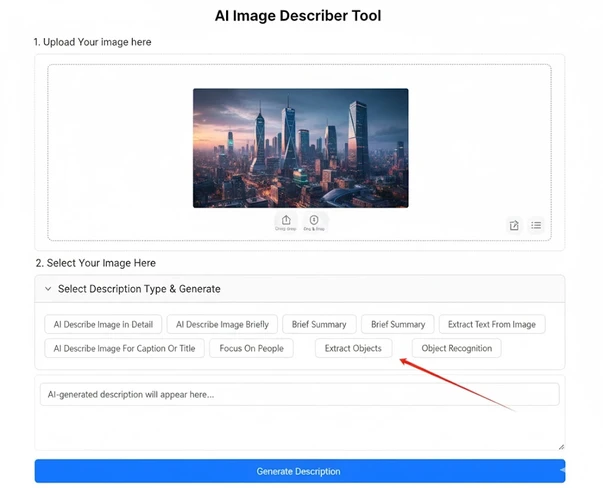
AI image describer tools play a key role in improving accessibility by providing detailed and accurate descriptions of visual content, bridging the gap between visual and non-visual experiences to make the web more inclusive.
With advancing AI technology, these tools have greatly improved by 2026. Whether you need an unfiltered option or one specialized for specific uses, they are essential for creating accessible, detailed, and engaging image descriptions. This article discusses the top 7 AI image describer tools available in 2026 to enhance image interactions across platforms.
Table of Contents
Part 1: Why AI Image Descriptions Matter
Before AI, creating accurate image descriptions was time-consuming and manual, leading to inconsistent tone, detail, and reliability. This inefficiency burdened media teams and digital publishers.
The emergence of AI image describer tools has transformed the process. Using multimodal learning, systems like GPT-4 Vision, CLIP Interrogator, and Microsoft Azure Vision analyze images and context to generate natural, detailed captions that capture scenes, objects, and even emotional elements.
Industries such as marketing, e-commerce, and accessibility design have rapidly adopted AI image describer tools—to enhance social media engagement, automate SEO-friendly tags, and create reliable alt text for inclusive digital content.
Part 2: 7 Popular AI Image Describer Tools and Platforms
From multimodal giants to specialized apps, these top AI image describer tools redefine image captioning in 2026, making digital content more inclusive and interactive than ever.
1.PixPretty Image Describer Tool
The new AI Image Describer Tool developed by PixPretty is oriented to providing accurate, context-based and automatic image descriptions. The PixPretty Image Describer Tool processes images, identifies key details, such as objects, scenes, and emotions, and comes up with detailed captions using the advantages of the recent AI technology. It is the best place where content creators, marketers, and accessibility teams can find to improve visual content with accurate descriptions in a shorter time. The PixPretty tool is time-saving and would be more accessible to visually impaired users because it makes the online content more inclusive.

Pros

Cons

Produces context-sensitive descriptions, namely, object, scene and emotion descriptions.
There are advanced features that one needs to subscribe to.
Easy to use interface; user-friendly not only to novices, but also to professionals.
The captions have fewer alternatives in terms of adjusting the tone or style.
Photos and text are have been treated faster and descriptions are generated, hence time saved.
Enables one to write descriptions of many pictures at a time, which is suitable for extensive projects.
Assist in easing the content load on the visually impaired users.
2. Vidnoz AI Image Describer
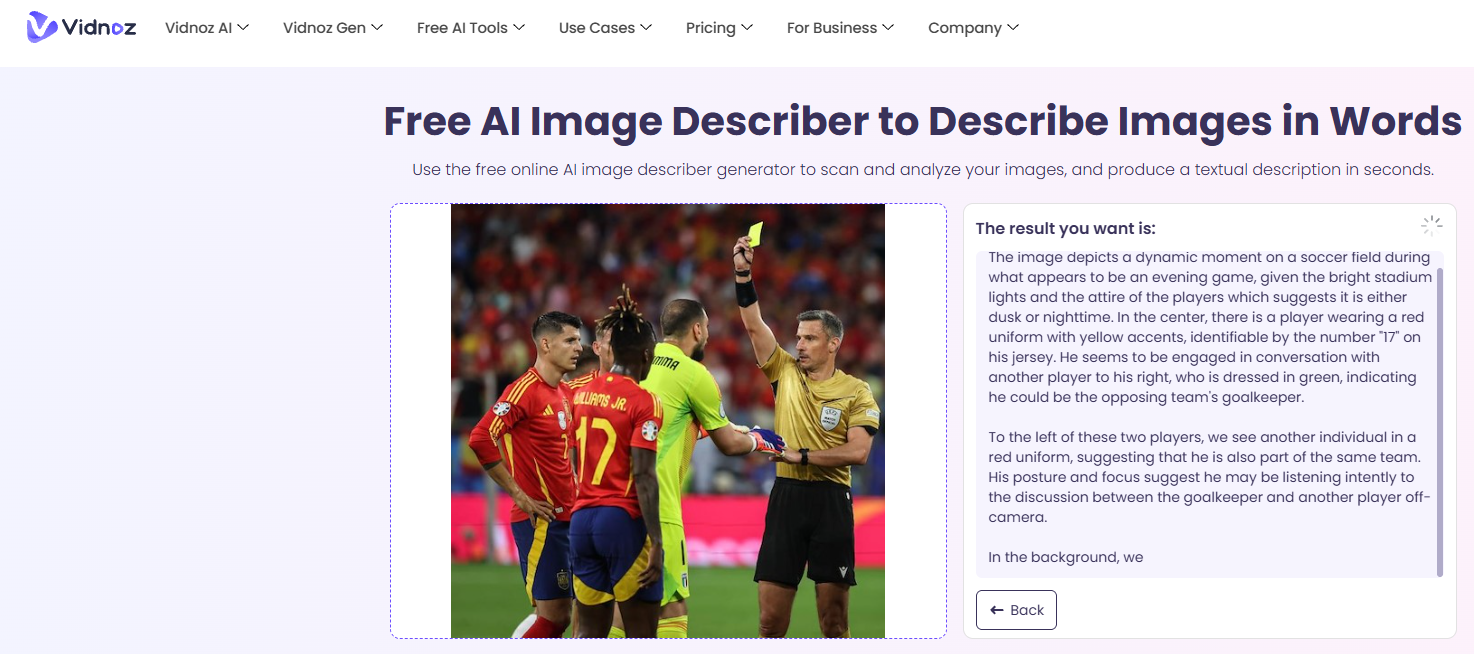
is a free online AI tool that transforms images into rich, contextual text descriptions instantly. It excels at analyzing complex scenes, landscapes, people, or infographics, producing natural-language outputs suitable for captions, accessibility, or creative prompts.
Pros
Cons
100% free with unlimited usage and no login required.
High accuracy (up to 95%) for detailed, context-aware descriptions.
Supports personal and commercial use without restrictions.
Simple upload interface with fast processing.
Photos and text are have been treated faster and descriptions are generated, hence time saved.
Primarily focused on general descriptions rather than highly stylized marketing copy.
Assist in easing the content load on the visually impaired users.
No built-in batch processing for multiple images.
Limited advanced customization options like keyword injection.
2. DocsBot AI Image Describer Tool
DocsBot AI is an effective picture description system that serves creators of content. It generates context-oriented captions in seconds, thus it suits better in blogs, learning materials, and improves the readability of the sites. Its interface is simple and enables users to come up with correct descriptions without having to edit them manually, which saves time and effort.
Pros:
Cons:
SEO-optimized and blog-friendly.
Lacks style templates for marketing captions.
No registration was required, and it supports several formats to work with (PNG, JPG, GIF, WEBP).
No heightened branding formatting.
It is also privacy-guaranteeing as it does not save pictures.
Limited to simple captions.
Free AI solutions for instant design.

4. AltText.ai Image Describer Tool
AltText.ai is an online artificial intelligence tool that aims at creating alt text to optimize search engine and accessibility. It generates concise descriptions that use keywords, which are best suited for websites, blogs, and online shopping. It has an adjustable tone and is WCAG compliant to make sure that your content is accessible and that it is also search engine friendly.
Pros:
Cons:
Search engine and user-friendly optimized.
It is not description-based but alt text-based.
Description Tone can be customized.
Restricted tone personalization in the free version.
General Shopify and WordPress compatibility.
No full API integration.
Websites' image support in bulk.

5. Image Describer Tool
Image Describer is an all-purpose AI solution that can be used to create a custom description of images. It can have short captions or long analysis, and it can accommodate high-resolution JPG and PNG, as well as templates when dealing with marketing, SEO, or artistic purposes, which makes it versatile in a variety of content.
Pros:
Cons:
Has a variety of languages.
Minimal templates not upgraded.
SEO and marketing templates are built in.
Too lengthy on brief captions.
Allows the description intent to be defined.
Sample images for guidance.

6. Pallyy Image Describer Tool
Pallyy is an artificial intelligence image description product targeted at social media creators. It creates human-like captions, which can be customized to be funny, informative, or casual. It is connected to social media planning applications, where it will enable users to develop interesting posts and monitor performance across devices on a single platform.
Pros:
Cons:
Inbuilt hashtags and post templates.
The free plan imposes restrictions on posts and accounts.
Performance tracking analytics tools.
In the event that prompts are not specified, captions can be generic.
Adjustable tones of captions.
Combines with social scheduling applications.

7. Modelia Image Describer Tool
Modelia is an AI image describer designed specifically to be used in e-commerce and, in particular, in the fashion domain. It creates brief and elaborate captions, which are ideal when listing products, posting ads, and using social media. Modelia is flexible, and the user can select the type of description of images.
Pros:
Cons:
Specializes in fashion and online business.
Primarily e-commerce and fashion.
Has short and detailed captions.
The free version is limited in features.
Weak language support in non-global languages.

Part 3: Tips and Best Practices
The following are some of the quick tips and best practices that would make you take the most of your AI image describer tools.
Use high-quality, clear images:
Post clear images, not cluttered and without a clue of the focus, to assist AI to work better.
Add a prompt or context (if supported):
Input tone/ theme (e.g., professional, funny) to make the description more specific to your audience.
Use in bulk when available:
Use the opportunity of batch processing and save time on large projects such as websites or social media planning.
Check accessibility standards:
For alt text, make sure that the description is brief, objective, and meaningful to the users of the screen readers.
Experiment with prompt tweaks:
Cinematic or macro are some of the other terms of style that can be incorporated to enhance creative captions.
Always review before posting:
Ensure that there is factual correctness and consistency in descriptions.
Avoid overloading keywords:
Be natural with descriptions; do not overload them with keywords.
Part 4: FAQ About Image Describer Tools
1. What are AI image description generator tools?
AI Image description generators This is a type of software that automatically generates captions or alt text description in images based on computer vision and natural language processing. They interpret visual materials to come up with the right and meaningful descriptions.
2. Who can benefit from using these tools?
AI image describer tools can be used by content makers, marketers, bloggers, e-commerce enterprises as well as accessibility professionals. They enhance search engine optimization, develop interaction and make contents more accessible to customers with visual disabilities.
3. Do AI image description generators improve SEO?
Yes, AIs enhance the searching capabilities of images in search engines such as Google. This helps in increasing SEO, which enhances ranking of images, and organic traffic to websites.
4. How does an image description generator process visual input?
AI applications interpret objects, context, illumination and design in pictures to create a detailed description. This makes it possible to have contextually sensitive, subtle outputs based on the type of content.
Final Thoughts
PixPretty Image Describer Tool using AI are essential in increasing accessibility, boosting search, and simplifying content development. These aids save time and assist in providing accurate description of the visual content so that more people, particularly the ones with visual impairments can be accommodated.
Regardless of marketing, e-commerce, or accessibility design, it is necessary to embrace AI-based image describers to remain relevant in a more digital world. These tools will only become better with the continued development of AI as it is able to provide an even more robust and personalized solution to both content creators and business enterprises.
PixPretty AI Photo Editor
- 100% free AI Image Generator (Nano Banana 2 powered)
- 4K image quality with fast generation speed
- AI effects & filters for personal and e-commerce use

Related Articles:


