In today's digital world, children are growing up surrounded by screens, smart toys, and voice assistants. Technology is no longer just entertainment-it's shaping how they learn, think, and imagine. But how can we make it meaningful? That's where the AI prompt for childhood comes in.
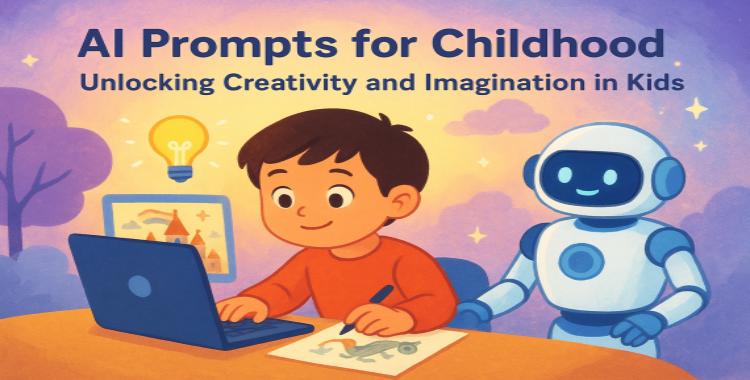
Instead of replacing creativity, AI can spark it-helping kids turn simple ideas into stories, drawings, and discoveries. With the right guidance, AI becomes more than a tool; it becomes a creative companion that helps children learn through curiosity, imagination, and play.
Table of Contents
✨ Part 1: What Is an AI Prompt for Childhood?
An AI prompt is a question, sentence, or idea designed to guide an AI model to generate a meaningful response. For children, these prompts become gateways to discovery. When a child says, "Write a story about a friendly robot who wants to learn how to dance," the AI responds with a colorful story that blends humor, empathy, and creativity.
These prompts can take many forms:
Storytelling prompts: to inspire writing and narrative skills.
Drawing prompts: to encourage visual creativity using AI art tools.
Learning prompts: to stimulate curiosity in science, history, or nature.
Role-play prompts: to help children imagine characters, situations, and dialogue.
AI prompts transform technology into a bridge between curiosity and knowledge - turning children from passive content consumers into active creators.
✨ Part 2: Why AI Prompts Matter in Early Learning?
Childhood is a time of wonder and imagination. With the right guidance, AI prompts can turn technology into a creative tool - helping children think, feel, and learn through play.

1. Encouraging Creative Thinking
Traditional lessons often lead to one "correct" answer.
AI prompts, like "What if clouds could talk?", invite endless imagination. They help kids dream freely, see possibilities everywhere, and discover that creativity has no limits.
2. Building Language and Storytelling Skills
When children write with AI, they learn naturally.
A prompt such as "A dragon who learns to read" teaches structure, vocabulary, and flow - without feeling like a lesson. Through stories, kids also develop empathy and emotional awareness.
3. Supporting Emotional Growth
AI prompts can help children express what words often can't.
Questions like "What makes you feel safe?" encourage reflection and confidence. By turning feelings into stories, kids learn to understand both themselves and others.
4. Blending Play and Learning
AI prompts make education fun.
Imagine "A pirate and a dolphin planning a treasure hunt."
Such playful prompts mix humor, logic, and imagination - turning learning into a game children love.
5. Empowering Parents and Teachers
AI prompts build bridges between adults and children.
Teachers can use them for writing workshops; parents can use them for bedtime storytelling. Each shared prompt becomes a moment of connection and discovery.
✨ Part 3: Creative AI Prompt for Kids
Below are some fun and meaningful AI prompt ideas you can try today. These work for storytelling, drawing, or interactive play:
- 1. Imagine your favorite toy can come alive for one day. What would you do together?
- 2. If you could create your own planet, what would it look like?
- 3. Write a letter from the moon to the Earth.
- 4. Draw a city made entirely of candy.
- 5. Describe your dream treehouse.
- 6. Invent a new animal that lives in the clouds.
- 7. Tell a story about a robot who learns to laugh.
- 8. Write a story about a shy dragon who wants to make friends.
- 9. Draw your perfect school – what subjects would you study there?
- 10. Imagine you could time travel to the childhood of your parents –what would surprise you the most?

Each of these prompts encourages active imagination, guiding children to express ideas in their own words or visuals.
When they describe feelings, build stories, or invent characters, they are not only creating, but also developing critical thinking and emotional awareness.
These prompts do not just entertain; they help children visualize, verbalize, and connect emotionally with the world around them.
✨ Part 4: Balancing Technology with Childhood Innocence
As powerful as AI prompts can be, balance is crucial. Childhood is also about sensory experiences - touching, building, running, exploring. Parents and educators must ensure that technology complements rather than replaces real-world play.
Here are some tips for responsible use:

⏳
Tip 1: Limit screen time and encourage offline reflection after AI activities.
Tip 2: Always review AI-generated content for appropriateness.
Tip 3: Use AI prompts as a starting point, not an endpoint — for example, if the AI helps a child write a story, have them illustrate it with crayons or act it out with friends.
Tip 4: Encourage open discussions about creativity, curiosity, and digital safety.
When used with mindfulness, AI prompts become tools for empowerment, not dependency.
✨ Part 5: The Future of AI Prompt for Childhood Learning
The role of AI in education is still evolving. Soon, AI tools could offer adaptive prompts that adjust to each child's learning style and emotional tone. Imagine an AI that recognizes when a child is feeling discouraged and responds with encouragement:
You're doing great! Let's finish this story together.

This kind of empathetic, interactive learning could redefine early education - not as a one-way lecture but as a two-way conversation between child and technology.
However, ethical awareness is key. Developers must design AI systems that prioritize privacy, inclusivity, and safety. Parents and teachers should teach children that AI is a creative assistant, not an all-knowing authority. The goal is to help kids grow curious, not dependent.
✨ Conclusion: Turning Curiosity into Creation
At its heart, an AI prompt for childhoodis more than a line of text - it's a spark of possibility. Each prompt opens a door to a story, a drawing, or an idea that might not have existed before.
When children learn to collaborate with AI, they are not just consuming technology; they are shaping it, guiding it with imagination and empathy. They discover that creativity isn't limited by age or ability - it only needs a beginning.
By integrating AI prompts into childhood learning, we nurture a generation of dreamers, storytellers, and problem-solvers - young minds ready to imagine the impossible and make it real. Because every invention, every piece of art, every beautiful story begins the same way - with a single prompt.
PixPretty AI Photo Editor
- 100% free AI Image Generator (Nano Banana 2 powered)
- 4K image quality with fast generation speed
- AI effects & filters for personal and e-commerce use